


















































































































































































































A value bet is any bet where the bookmaker’s odds imply a lower probability than the true probability of the outcome. It is the foundation of every serious long-term betting strategy. This guide explains what value betting is, how to calculate whether a bet has positive expected value, where value comes from in betting markets, and how to apply it consistently.
Table of Contents
- A value bet exists when the bookmaker’s implied probability is lower than the true probability of the outcome happening.
- Value is expressed as expected value (EV). A positive EV bet is profitable in the long run even if it loses on any given occasion.
- Bookmakers are not perfectly accurate. Value opportunities arise from slow line adjustments, sharp money, market inefficiencies, and niche markets with lower liquidity.
- Finding value requires estimating true probability independently, which means going beyond the bookmaker’s implied probability and forming your own view.
- Even a small consistent edge (2-5%) compounds into significant profit over a large enough sample of bets.
- Value betting only works long-term. Short-term variance means losing runs are inevitable even when betting with genuine edge.
What Makes a Bet a Value Bet
Every bookmaker price contains two pieces of information: the implied probability of an outcome and a built-in margin. When the actual probability of an outcome happening is higher than the probability the bookmaker has priced in, the odds are offering more than fair value. That gap between true probability and implied probability is what makes a bet a value bet.
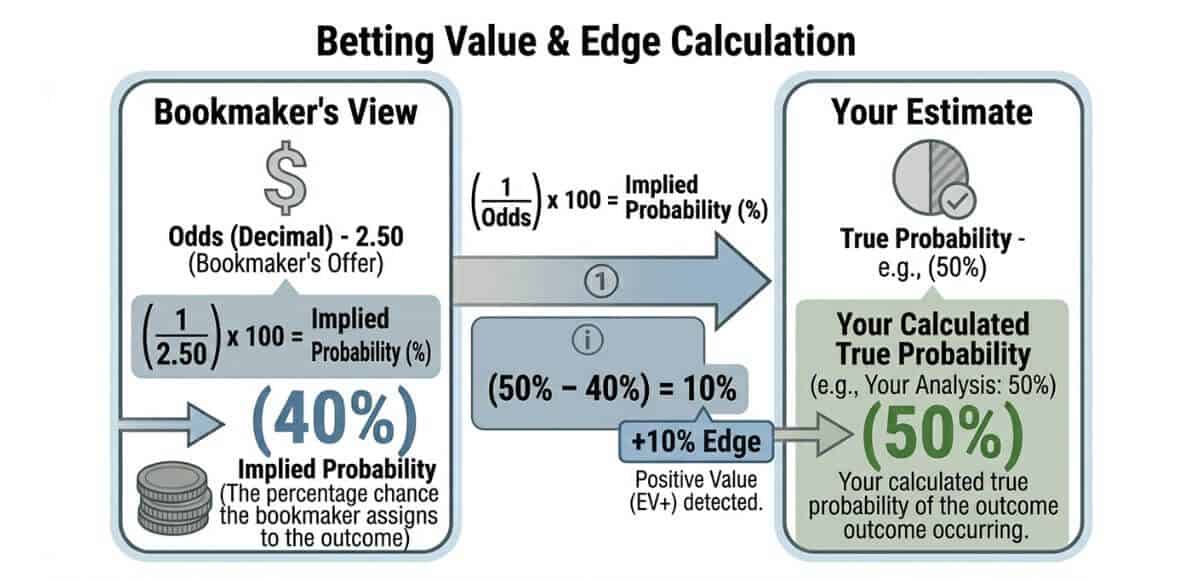
A concrete example: a bookmaker prices a football team’s home win at 2.50 decimal, implying a 40% chance. Your analysis, based on form, head-to-head records, and expected lineups, puts the true probability of a home win at 50%. The bookmaker is underestimating the home side by 10 percentage points. That gap is positive expected value, and the bet is worth placing.
The same logic runs in reverse. If your analysis puts the true probability at 35% and the bookmaker implies 40%, the odds are not generous enough to justify the risk. That bet has negative expected value and should be skipped regardless of whether the outcome feels likely.
How to Calculate Expected Value
Expected value (EV) is the mathematical expression of the edge on a single bet. It tells you the average profit or loss per unit staked over a large number of identical bets.
Formula: EV = (True Probability x Profit) minus (True Probability of Losing x Stake)
Or in a cleaner form using decimal odds:
If the result is above zero, the bet has positive expected value. If it is below zero, the bet has negative expected value.
Using the example above:
- Decimal odds: 2.50
- True probability estimate: 50% (0.50)
- EV = (0.50 x 2.50) minus 1 = 1.25 minus 1 = +0.25
A result of +0.25 means that on average, for every £1 staked on this bet repeatedly, you would expect to gain £0.25. Over 100 bets at £10 each, the expected profit is £250. No individual bet is guaranteed to win, but the edge accumulates over volume.
| True Probability | Decimal Odds | EV per £1 Staked | Edge |
|---|---|---|---|
| 50% | 2.50 | +0.25 | +25% |
| 50% | 2.00 | 0.00 | 0% (fair) |
| 50% | 1.80 | -0.10 | -10% |
| 40% | 2.50 | 0.00 | 0% (fair) |
| 40% | 2.80 | +0.12 | +12% |
| 30% | 4.00 | +0.20 | +20% |
The expected value calculator runs this calculation automatically, which is useful when comparing multiple potential bets across different odds and probability estimates.
Where Value Comes From
Value does not appear randomly. It arises from specific, identifiable sources of inefficiency in how bookmakers price markets.
Slow Line Adjustments
When new information enters a market (a confirmed injury, a lineup change, weather conditions), sharper bookmakers adjust their odds within minutes. Softer bookmakers are slower to react. During that window, their odds still reflect outdated information, and the gap between their price and the true probability represents a value opportunity.
Bettors who monitor opening odds vs closing odds can identify which direction sharp money is pushing a line and use that signal to assess whether a price at open still represents fair value by kick-off.
Market Liquidity
Bookmakers devote the most analytical resource to high-profile, high-volume markets: Premier League fixtures, major tennis tournaments, top NFL games. In lower-liquidity markets (lower league football, minor tournaments, niche sports), their models are thinner, their analysts are stretched, and pricing errors are more common. Bettors with genuine subject-matter knowledge in these areas can exploit the gap.
Bookmaker Competition
When multiple bookmakers compete for the same market, prices often drift slightly in the bettor’s favour as each tries to attract action. Comparing the same outcome across several bookmakers frequently reveals one outlier offering a price that implies a meaningfully lower probability than the consensus. That outlier is offering value.
Overreaction to Public Sentiment
Bookmakers adjust lines based on betting volume as well as true probability. When the public heavily backs one side (a popular team, a high-profile player), the bookmaker shortens those odds to balance their liability, which lengthens the odds on the opposing side beyond their true probability. Bettors who can identify when line movement is driven by public sentiment rather than genuine information can find value on the unpopular side.
Estimating True Probability
The central challenge of value betting is forming an accurate, independent estimate of true probability. Without it, you have no basis for comparison against the bookmaker’s implied probability.
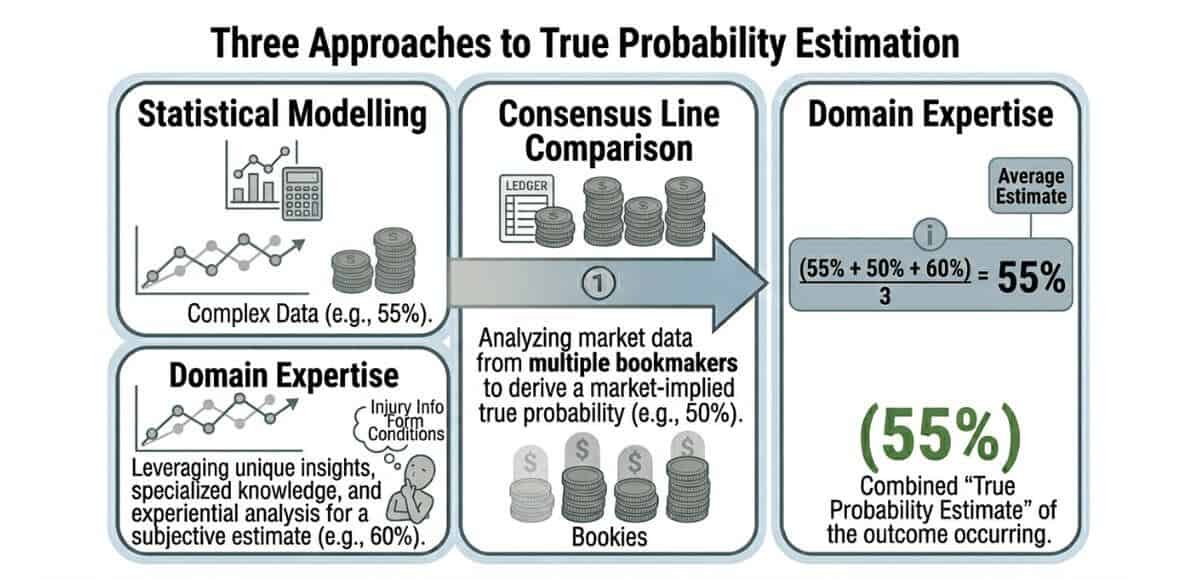
The most common approaches are:
Statistical modelling. Using historical match data, team and player performance metrics, and relevant contextual factors (home advantage, rest days, injuries) to build a probability estimate from scratch. The Poisson distribution calculator is a structured way to do this for football matches, using goal expectancy to generate win, draw, and loss probabilities.
Consensus line comparison. Using the average implied probability across several sharp bookmakers as a proxy for the true probability, then looking for any individual bookmaker that is significantly above that consensus. This approach is more accessible for beginners but relies on the assumption that sharp bookmakers are accurately priced, which is not always the case.
Domain expertise. Deep knowledge of a specific sport, league, or market type gives an edge when bookmakers underestimate factors that experienced observers can identify: tactical matchups, travel fatigue in low-profile competitions, referee tendencies, or surface-specific performance in tennis.
Each approach has limitations. Statistical models rely on the quality and depth of the data available. Consensus comparison depends on sharp lines being accurate. Domain expertise is subjective and vulnerable to bias. The strongest probability estimates combine at least two of these approaches.
A Full Value Bet Workflow
Applying value betting in practice follows the same steps every time:
- Select a market — focus on markets where you have knowledge or where bookmaker pricing is known to be less efficient.
- Estimate true probability independently — using one or more of the methods above, before looking at the bookmaker’s price.
- Convert the bookmaker’s odds to implied probability — use the standard formula or the odds calculator for speed.
- Compare your estimate against the implied probability — if your estimate is higher than the bookmaker’s implied probability, the bet has positive expected value.
- Calculate EV to size the opportunity — a +5% edge on a 2.00 bet is different in scale from a +5% edge on a 1.20 bet. EV tells you which opportunity is actually worth more per unit staked.
- Decide stake size — flat staking is the simplest approach for beginners. The Kelly Criterion calculator calculates the theoretically optimal stake based on your edge and bankroll, though full Kelly is aggressive in practice and most bettors use a fractional version.
- Record the bet — tracking every bet with the estimated probability, the odds taken, and the outcome is essential for measuring whether your edge is real over time.
Value Betting vs Other Strategies
Value betting is often compared to related strategies. The distinctions are important.
Value betting vs matched betting. Matched betting uses free bet promotions and lay betting to lock in guaranteed profit regardless of outcome. Value betting carries no guaranteed profit on any single bet. The advantage of value betting is that it works indefinitely and is not dependent on available promotions.
Value betting vs arbitrage. Arbitrage betting involves backing all outcomes of the same event across different bookmakers to guarantee a profit regardless of result. Like matched betting, it requires no probability estimation. Unlike value betting, arbitrage opportunities are rare, require fast execution, and are quickly flagged by bookmakers. The arbitrage calculator identifies whether a combination of prices across bookmakers creates a guaranteed margin.
Value betting vs point spread betting. Point spread betting is a market format, not a strategy. Value betting can be applied to point spread markets exactly as it is applied to moneyline markets: estimate the true probability of covering the spread, compare it to the implied probability in the offered juice, and bet when the edge is positive.
The Role of Variance
A common mistake is judging a value betting strategy by short-term results. Even with a genuine edge, losing runs of 10, 20, or more consecutive bets are statistically normal. The edge only becomes visible over a large sample size, typically hundreds of bets.
This is why bankroll management is inseparable from value betting. Without a large enough bankroll relative to individual stake sizes, a normal variance run can wipe out the account before the edge has had enough bets to express itself.
A rough guide: with a 5% edge betting at flat 2% of bankroll per bet, a losing streak of 15 consecutive bets (which is statistically likely at some point over 500 bets) reduces the bankroll by approximately 26%. That is survivable. At 10% of bankroll per bet, the same streak is near-terminal.
FAQ
QWhat is a value bet in simple terms?
QHow do you know if a bet has value?
QCan value betting guarantee profit?
QWhy do bookmakers allow value bets to exist?
QHow many bets do you need to see if your edge is real?
QDoes value betting work in all sports?