


















































































































































































































Implied probability is the single most important number hidden inside every set of odds. It converts a bookmaker’s price into the percentage chance they believe an outcome will happen, and it reveals the margin they have built in against you. This guide covers the formulas for all three odds formats, shows how to calculate the overround in any market, and explains how to use implied probability to find bets where the price is in your favour.
Table of Contents
- Implied probability is the percentage chance a bookmaker assigns to an outcome, expressed through their odds.
- Every odds format (decimal, fractional, American) has its own conversion formula, but all produce the same result.
- The implied probabilities across all outcomes in a market always add up to more than 100% because bookmakers build a profit margin (called the overround or vig) into every market.
- The gap between implied probability and true probability is where betting value lives. When your assessed probability is higher than the bookmaker’s, you have a value bet.
- In a standard football three-way market, the overround typically sits between 3% and 8% depending on the bookmaker and market.
- Understanding implied probability is the foundation of all serious betting analysis, including value betting, expected value, and line shopping.
What Implied Probability Actually Means
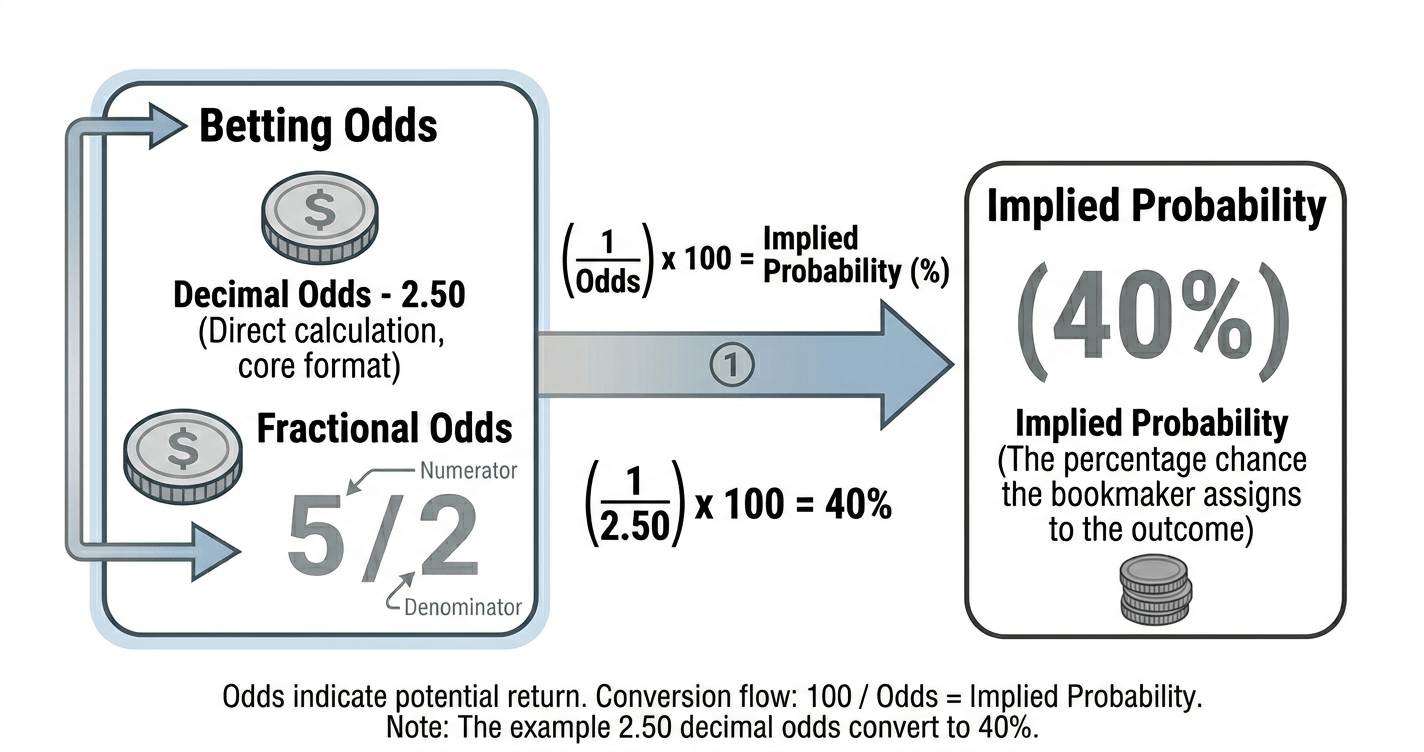
When a bookmaker sets odds on a match, they are not just setting a payout. They are expressing a view on how likely each outcome is. Implied probability is the reverse calculation that translates the published odds back into that percentage likelihood.
The word “implied” is key. The probability is not stated outright. It is embedded in the odds, and you have to extract it with a formula. Once you have it as a percentage, you can compare it directly against your own assessment of the true probability of that outcome. Bettors who understand how bookmakers work and the margin they build into every price are already thinking about implied probability, even if they have never called it that.
Implied Probability Formulas by Odds Format
The formula you use depends on which format the bookmaker is displaying. All three produce the same underlying probability.
From Decimal Odds
Decimal odds are the simplest to convert because the relationship is a direct reciprocal.
| Decimal Odds | Calculation | Implied Probability |
|---|---|---|
| 1.25 | (1 ÷ 1.25) × 100 | 80.0% |
| 1.50 | (1 ÷ 1.50) × 100 | 66.7% |
| 2.00 | (1 ÷ 2.00) × 100 | 50.0% |
| 2.50 | (1 ÷ 2.50) × 100 | 40.0% |
| 4.00 | (1 ÷ 4.00) × 100 | 25.0% |
| 10.00 | (1 ÷ 10.00) × 100 | 10.0% |
Odds of 2.00 always imply exactly 50%. This is the break-even point and the boundary between favourites (below 2.00) and underdogs (above 2.00). The full what are betting odds breakdown covers this boundary in detail, alongside how each format expresses it differently.
From Fractional Odds
Fractional odds require you to use both the numerator and denominator.
| Fractional Odds | Calculation | Implied Probability |
|---|---|---|
| 1/4 | 4 ÷ (1 + 4) × 100 | 80.0% |
| 1/2 | 2 ÷ (1 + 2) × 100 | 66.7% |
| 1/1 (Evens) | 1 ÷ (1 + 1) × 100 | 50.0% |
| 6/4 | 4 ÷ (6 + 4) × 100 | 40.0% |
| 3/1 | 1 ÷ (3 + 1) × 100 | 25.0% |
| 9/1 | 1 ÷ (9 + 1) × 100 | 10.0% |
The denominator represents “your stake” and the numerator represents “your profit.” Adding them together gives the total payout, and dividing your stake by total payout gives the probability.
From American (Moneyline) Odds
American odds use two separate formulas depending on whether the line is positive or negative. Moneyline odds use a +/- sign system where positive numbers represent underdogs and negative numbers represent favourites, which is why the two formulas split at that boundary.
For positive odds (+): Implied Probability (%) = 100 / (Odds + 100) x 100
For negative odds (-): Implied Probability (%) = Absolute Value / (Absolute Value + 100) x 100
| American Odds | Formula Applied | Implied Probability |
|---|---|---|
| +300 | 100 ÷ (300 + 100) × 100 | 25.0% |
| +150 | 100 ÷ (150 + 100) × 100 | 40.0% |
| +100 | 100 ÷ (100 + 100) × 100 | 50.0% |
| -125 | 125 ÷ (125 + 100) × 100 | 55.6% |
| -200 | 200 ÷ (200 + 100) × 100 | 66.7% |
| -400 | 400 ÷ (400 + 100) × 100 | 80.0% |
📷 IMAGE SUGGESTION: A three-panel graphic showing the same outcome (40% implied probability) displayed as decimal odds 2.50, fractional odds 6/4, and American odds +150, with the relevant formula shown underneath each panel
The Overround: Why the Probabilities Never Add Up to 100%
If you convert the odds on all possible outcomes in a market and add the implied probabilities together, the total will always be higher than 100%. This excess percentage is the bookmaker’s overround (also called the vig, juice, or margin), and it is their built-in profit guarantee.
Two-Way Market Example
Take a tennis match with no draw possibility:
- Player A wins: 1.80 decimal (implied probability: 55.6%)
- Player B wins: 2.10 decimal (implied probability: 47.6%)
- Total: 103.2%
The extra 3.2% above 100% is the overround. In a fair market with no margin, both prices would be set so the total implied probability equals exactly 100%. Instead, the bookmaker shades each price slightly in their favour, meaning the odds on both sides are slightly worse than the true probability warrants.
Three-Way Market Example (Football)
A Premier League match:
| Outcome | Odds | Implied Probability |
|---|---|---|
| Home win | 2.10 | 47.6% |
| Draw | 3.40 | 29.4% |
| Away win | 3.60 | 27.8% |
| Total | 104.8% |
The overround here is 4.8%. For every £100 wagered evenly across all three outcomes, the bookmaker expects to retain £4.80 on average, regardless of the result.
The lower the overround, the better the value for the bettor. Betting exchanges typically run overrounds of 1-2% because they charge commission rather than building margin into the odds. Traditional bookmakers typically run 4-8% on major markets, with higher margins on niche or lower-liquidity markets.
True Probability vs Implied Probability
Implied probability reflects the bookmaker’s view, adjusted for their margin. True probability is your independent assessment of how likely an outcome actually is, based on your own research, models, or analysis.
The relationship between the two determines whether a bet has positive or negative expected value:
| Scenario | Implied Probability | Your True Probability | Result |
|---|---|---|---|
| Value bet | 40% (odds of 2.50) | 50% | Positive expected value |
| Fair bet | 40% (odds of 2.50) | 40% | Break-even long-term |
| Bad bet | 40% (odds of 2.50) | 30% | Negative expected value |
When your assessed true probability is higher than the bookmaker’s implied probability, the bet has positive expected value and is worth considering. When it is lower, you are taking the worse side of the price. The expected value calculator takes both your probability estimate and the odds and returns the exact EV figure per unit staked.
Removing the Margin: No-Vig Fair Odds
To compare your true probability against the bookmaker’s actual view (rather than their margin-adjusted view), you need to strip the overround out and calculate the no-vig implied probability for each outcome.
Using the three-way football example above (total overround = 104.8%):
| Outcome | Raw Implied Probability | No-Vig Probability |
|---|---|---|
| Home win | 47.6% | 47.6 ÷ 104.8 × 100 = 45.4% |
| Draw | 29.4% | 29.4 ÷ 104.8 × 100 = 28.1% |
| Away win | 27.8% | 27.8 ÷ 104.8 × 100 = 26.5% |
| Total | 104.8% | 100.0% |
The no-vig probabilities now total exactly 100% and represent the bookmaker’s true view of the match without the profit margin layered on top. Comparing your own probability estimate against the no-vig figure is a cleaner measure of value than comparing against the raw implied probability.
Using Implied Probability for Line Shopping
Once you can calculate implied probability, you can use it to compare the same market across multiple bookmakers and identify which one is offering the best price for your chosen outcome.
For example, three bookmakers pricing the same outcome:
| Bookmaker | Odds | Implied Probability |
|---|---|---|
| Bookmaker A | 2.40 | 41.7% |
| Bookmaker B | 2.50 | 40.0% |
| Bookmaker C | 2.55 | 39.2% |
Bookmaker C’s price implies the lowest probability of the outcome occurring, meaning they are giving you the best value on this selection. Always take the lowest implied probability available across bookmakers for any given outcome, as this directly translates to the highest potential return.
Bettors who track opening odds vs closing odds take line shopping a step further: when implied probability on a side shortens significantly between market open and kick-off, it signals that professional money has moved that line and the closing price is closer to the true probability.
Implied Probability in Practice: A Full Match Example
A useful way to build true probability estimates for any match is through a Poisson distribution model, which uses historical goal-scoring data to generate outcome probabilities from scratch. Take a Champions League match with the following estimates:
- Home win: 52%
- Draw: 24%
- Away win: 24%
The bookmaker is offering:
| Outcome | Odds | Implied Prob. | No-Vig Prob. | Your Estimate |
|---|---|---|---|---|
| Home win | 1.95 | 51.3% | 48.9% | 52% |
| Draw | 3.50 | 28.6% | 27.2% | 24% |
| Away win | 4.20 | 23.8% | 22.7% | 24% |
| Total | 103.7% | 100% | 100% |
Your estimated probability of a home win (52%) is higher than both the raw implied probability (51.3%) and the no-vig probability (48.9%). The home win has positive expected value based on your model. The draw and away win are fairly priced or slightly overpriced, so you would pass on those.
Quick Reference: All Formulas
| What You Need | Formula |
|---|---|
| Implied probability from decimal | (1 ÷ Decimal Odds) × 100 |
| Implied probability from fractional | Denominator ÷ (Numerator + Denominator) × 100 |
| Implied probability from American (+) | 100 ÷ (Odds + 100) × 100 |
| Implied probability from American (-) | Absolute Value ÷ (Absolute Value + 100) × 100 |
| Overround | Sum of all implied probabilities − 100 |
| No-vig probability | (Raw Implied Probability ÷ Total Implied Probability) × 100 |
The odds calculator converts between all three formats and outputs the implied probability alongside the conversion, which is useful when assessing multiple markets quickly.
FAQ
QWhat is implied probability in betting?
QWhy do implied probabilities add up to more than 100%?
QWhat is the difference between implied probability and true probability?
QHow is implied probability used to find value bets?
QWhat is a typical overround for a football match?
QDoes implied probability tell you which team will win?