






























































































































































































































A BTTS bet asks a single question: will both teams score at least one goal in this match? The result does not matter. The scoreline does not matter. As long as each side finds the net at least once within the 90 minutes, a BTTS Yes bet wins. This guide covers how the market works, all major variations, the statistical factors that drive selection, and how to find value on both sides of the market.
Table of Contents
- BTTS (Both Teams to Score) is a binary Yes/No football market settled on whether each team scores at least once in 90 minutes, including injury time but excluding extra time and penalties.
- In the 2024-25 Premier League season, 59% of matches fulfilled BTTS criteria. Rates vary by league, from around 62% in the Bundesliga down to 50% in Serie A, making league context a key input in probability estimates.
- BTTS Yes odds in competitive fixtures typically range from 1.50 to 2.50, reflecting implied probabilities of roughly 40% to 67%.
- The most analytically reliable inputs for BTTS selection are expected goals (xG), both scored and conceded, rather than raw results or recent form alone.
- BTTS No is a genuine value market, particularly in low-scoring fixtures or where one team has a dominant defensive record and the opposition scores infrequently.
- BTTS combines cleanly with result and over/under markets in Bet Builder formats, but each added leg multiplies the margin the bookmaker charges.
What BTTS Means and How It Settles
BTTS stands for Both Teams to Score. In the standard market, you choose either Yes (both teams will score at least one goal each) or No (at least one team will fail to score). The final result is irrelevant to settlement. A 1-1 draw, a 3-1 win, a 2-2 draw, all settle BTTS Yes. A 1-0 result, a 0-0 draw, or a 2-0 win settle BTTS No, regardless of which team dominates.
Settlement is based on 90 minutes plus injury time only. Goals in extra time and penalties do not count. This is standard across sportsbooks and applies whether the fixture is a league game or a cup knockout where the 90-minute result is then followed by additional time.
Own goals count toward BTTS settlement. If a defender puts the ball into his own net during regular time, that goal satisfies the scoring requirement for his team’s opponents. A match that ends 1-0 via an own goal still settles BTTS No, because only one team scored. A match that ends 1-1 where one goal was an own goal still settles BTTS Yes.
BTTS Market Variations
The standard Yes/No market is the foundation, but most bookmakers offer a range of BTTS-based combinations. If you are new to football betting markets generally, the sports betting for beginners guide covers the core market types before you encounter the variations below. Understanding each one matters before committing stakes.
BTTS and Win combines the BTTS condition with a match result. You pick a team to win and require both teams to score. Manchester City to win and BTTS only settles as a winner if City win the match and the opponent scores at least once. A City clean-sheet win loses the bet. The additional condition raises the odds substantially but narrows the probability of success.
BTTS in Both Halves requires each team to score at least one goal in the first half and at least one goal in the second half. Both teams scoring once each across 90 minutes is not sufficient. This is a high-odds, low-frequency market. In most top-flight leagues, BTTS in Both Halves settles as Yes in fewer than 20% of matches, which reflects the difficulty of both teams scoring before the break.
BTTS and Over/Under Goals ties the BTTS condition to a total goals threshold. BTTS and Over 2.5 Goals, for example, requires both teams to score and the total match goals to exceed two. Because matches where both teams score tend to produce higher goal totals on average, BTTS and Over 2.5 is a relatively natural combination. BTTS and Over 3.5 increases the threshold and narrows the qualifying scorelines further.
BTTS and No Draw is a market where both teams must score and neither can draw the match. Any team can win. The condition excludes scorelines like 1-1 and 2-2, which settle as draws. In fixtures where both teams scoring is likely but the match result is genuinely uncertain, this exclusion makes the market more selective than BTTS and Win on either specific side.
First-Half BTTS and Second-Half BTTS are standalone half-time markets. First-half BTTS requires both teams to score before 45 minutes. It settles at half-time and is independent of what happens in the second half. Second-half BTTS requires both teams to score after the break. Both carry elevated odds relative to full-match BTTS, reflecting the lower base rate of goals in any given 45-minute window.
How Bookmakers Price BTTS Markets
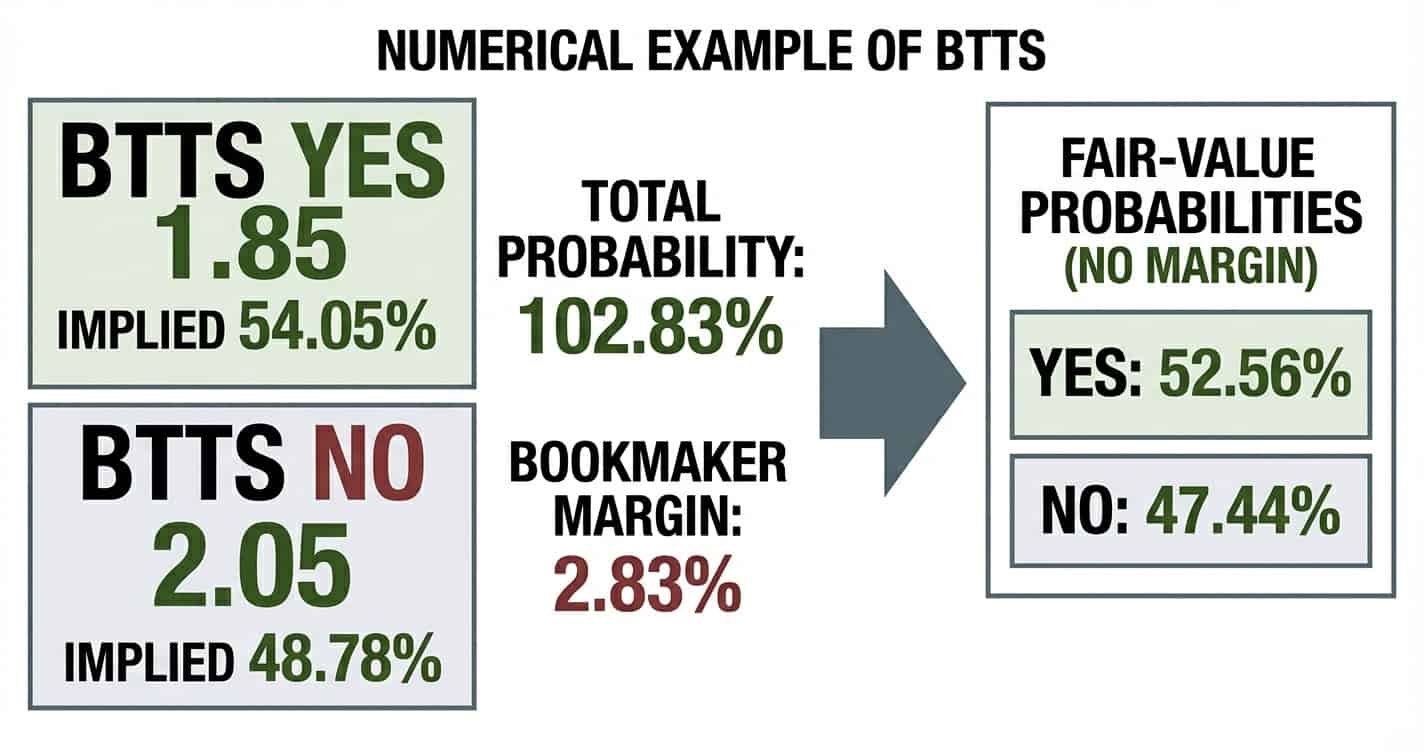
BTTS odds are priced using the same margin structure that applies to all football markets. The bookmaker calculates an implied probability for Yes and for No, applies their margin, and sets prices that reflect their assessment of the match. Understanding how this works helps identify when market prices might drift from fair value.
For a balanced BTTS market with no margin, the implied probabilities of Yes and No would sum to exactly 100%. In practice, they sum to more than 100% because the bookmaker’s margin is embedded in both prices. On a match priced at Yes 1.80 and No 2.10, the implied probabilities are 55.6% and 47.6%, summing to 103.2%. The 3.2% excess is the bookmaker’s margin on this market.
Using the implied probability formula to convert both prices and compare their sum to 100% tells you the total margin on the market. Removing that margin proportionally gives you a cleaner estimate of the bookmaker’s actual probability assessment. This is the starting point for assessing whether the price represents value relative to your own estimate.
The Statistical Case for BTTS Yes and No
In high-scoring leagues, BTTS Yes is the majority outcome. The table below shows approximate BTTS Yes rates across major European leagues in the 2024-25 season, based on full-season results data from our platform:
| League | Approx. BTTS Yes Rate (2024-25) |
|---|---|
| Bundesliga | 62% |
| Premier League | 59% |
| La Liga | 56% |
| Ligue 1 | 52% |
| Serie A | 50% |
These league-level base rates matter because they establish a prior probability before any match-specific information is applied. A BTTS Yes bet at 1.90 implies the bookmaker estimates a 52.6% chance of both teams scoring. In a Premier League context where the league average is 59%, a 52.6% implied probability on Yes already looks conservative before you have looked at the specific teams involved.
Match-specific factors then move the probability up or down from that baseline. The most reliable factors, in approximate order of analytical reliability, are:
Expected goals (xG) allowed is the most useful single defensive metric for BTTS analysis. A team that concedes high xG in most matches, regardless of whether those chances convert, is consistently vulnerable to being scored against. xG is more stable across a season than actual goals conceded, which fluctuates based on finishing variance and goalkeeper performance.
Expected goals scored on the attacking side gives the corresponding picture. A team producing high xG in most matches will score more consistently than raw form or recent goal counts suggest, particularly when accounting for matches where they produced chances but did not convert.
Clean sheet rate over 10 or more matches is a more stable metric than the last five results. Teams with a clean sheet rate above 40% are significantly less likely to concede in any given match than teams below 20%.
Head-to-head history in similar conditions (home/away context, similar league position) is useful but limited. Three to five matches between the same opponents is a very small sample. It is a secondary input, not a primary one.
Home and away splits carry more weight than combined season stats for most teams. Defensive records at home and away often differ substantially, and a team that concedes frequently away from home may hold clean sheets at home regularly.
Using the Poisson Distribution for BTTS Probability
The Poisson distribution is a statistical model that calculates the probability of a given number of goals being scored in a match when the average goal rate of each team is known. It is the standard analytical tool used by quantitative bettors for football goal markets, and BTTS probability is a direct output of it.
The logic is straightforward. If Team A scores an average of 1.4 goals per match, the Poisson distribution gives the probability of them scoring zero goals in any given match. If Team B scores an average of 1.2 goals per match, the same calculation gives their probability of scoring zero. The probability that neither team scores zero is the BTTS Yes probability.
Using xG-adjusted averages rather than raw goals scored improves accuracy, since xG smooths out finishing variance over the season. The Poisson distribution calculator handles this calculation directly. Enter each team’s average goals scored (or xG scored per match adjusted for the opponent’s defensive quality) and it returns the probability of each team scoring zero, which you can use to derive BTTS probability manually or compare against the bookmaker’s implied probability.
To make this concrete, consider a Premier League fixture where Team A averages 1.6 xG scored per match and Team B averages 1.3 xG scored per match. Applying the Poisson formula:
- P(Team A scores 0) = e^(−1.6) = 0.202 (approximately 20.2%)
- P(Team B scores 0) = e^(−1.3) = 0.272 (approximately 27.2%)
- P(BTTS Yes) = (1 − 0.202) × (1 − 0.272) = 0.798 × 0.728 = 58.1%
If the bookmaker is offering BTTS Yes at 1.90, the implied probability is 52.6%. Your modelled probability is 58.1%. The difference, 5.5 percentage points, represents a positive edge. The expected value calculator formalises this comparison, converting the probability estimate and the available odds into a clear EV figure.
Finding Value in BTTS No
BTTS No is an underused market that most recreational bettors ignore because it feels like betting against goals. In leagues where both teams score in 55-60% of matches, the No outcome is a 40-45% probability event, often priced at 2.00-2.20. In the right fixture, this represents better value than the Yes side.
The strongest BTTS No setups share three characteristics. One team has a dominant defensive record, with a clean sheet rate above 40% and low xG allowed per match. The opponent has a low xG scored rate, meaning they consistently produce few quality chances regardless of recent results. The fixture context is low-stakes, such as a mid-table team defending a lead in the second leg of a two-legged fixture, or a team with nothing to play for in the final weeks of the season.
When these three factors align and the bookmaker’s No odds imply a lower probability than your own estimate, BTTS No is as analytically valid a selection as any Yes bet. Understanding how bookmakers set and adjust their prices reveals why the No side of the market sometimes drifts into mispriced territory, particularly as public sentiment drives money onto the Yes side of open, attacking-looking fixtures.
BTTS in Accumulators
BTTS bets combine naturally with other BTTS selections in accumulators because the market is independent of the result. A five-leg BTTS accumulator across five different matches multiplies the implied probability of each individual selection. At average odds of 1.85 per leg (approximately 54% implied probability each), the accumulator odds are approximately 21.70, reflecting a combined probability of around 4.6%.
The mechanical issue with BTTS accumulators is the same as with any multi-leg bet: each selection carries the bookmaker’s full margin. Five legs at a 5% margin each compounds to a margin considerably larger than any single-match bet. The accumulator calculator makes this visible by showing the fair-value return at no-margin odds alongside the actual accumulator payout.
A five-leg BTTS accumulator can deliver value if each individual leg represents genuine positive expected value, but that requires each selection to be assessed with the same analytical rigour as any standalone bet. Grouping five matches into an accumulator because they all look “goal-friendly” without calculating the implied probability gap on each leg is the equivalent of blindly adding to a value bet without assessing whether any of the prices represent an edge over the bookmaker.
Odds, Probability, and When to Bet BTTS Yes or No
The odds available on BTTS markets shift between the opening line and kick-off based on team news, injury updates, and public betting volume. A team missing their first-choice goalkeeper or a key centre-back will cause the Yes odds to shorten and the No odds to lengthen as the market reflects the increased likelihood of goals. A team missing their first-choice striker has the opposite effect.
Opening odds versus closing odds move for BTTS markets in predictable ways. Early team news releases the sharpest money. By kick-off, the closing price on a high-profile fixture is a significantly more efficient reflection of probability than the opening price was. In most cases, the best odds for Yes on a match where you have identified early analytical reasons to expect both teams to score will be found before the news cycle closes the gap.
The odds calculator converts BTTS prices between decimal, fractional, and American formats, which is useful when comparing the same market across different bookmakers or regions.
In-Play BTTS: When to Enter Live
In-play BTTS betting carries a specific timing logic that pre-match analysis cannot replicate. The optimal entry point for a BTTS Yes bet in-play is a 0-0 scoreline with a fast pace of play — high shot count, strong live xG accumulating on both sides, and sustained attacking pressure from each team in the first 20-30 minutes. At that point, neither team has scored yet, so the BTTS Yes odds are still available. The match is demonstrating empirically, in real time, that both attacks are active and both defences are exposed.
The risk of waiting for in-play entry is that an early goal immediately changes the market. Once one team scores, the BTTS Yes odds shorten sharply if the goal energises the match, or they may lengthen if the scoring team retreats to defend. Bettors who identify a high-BTTS fixture pre-match and want to confirm their read before committing are better positioned entering at 0-0 with a clear attacking picture than waiting for a goal to prompt the decision.
FAQ
QWhat does BTTS mean in betting?
QDoes a 0-0 draw win a BTTS bet?
QDoes BTTS apply to extra time?
QWhat is the difference between BTTS and Win and BTTS No Draw?
QHow are BTTS odds calculated?
QIs BTTS a good bet for accumulators?