
























































































































































































































Decimal odds are the most widely used betting format in the world and the easiest to calculate: multiply your stake by the decimal number and you get your total return, including your stake back. A bet at 3.50 with a EUR 10 stake returns EUR 35.00 in total.
Table of Contents
This guide covers everything you need to know to read, calculate, and use decimal odds confidently.
- Decimal odds show your total return per unit staked, stake included. Multiply your stake by the decimal number and the result is everything you get back.
- Odds of 2.00 are the break-even point. Below 2.00 is a favourite, above 2.00 is an underdog.
- Decimal odds are the standard format across Europe, Australia, Canada, and all major betting exchanges including Betfair.
- Converting decimal odds to implied probability takes one step: divide 1 by the odds. No separate formula for favourites and underdogs.
- Decimal odds make accumulator calculations straightforward: simply multiply each selection’s odds together to get the combined odds.
- Most betting sites let you switch to decimal format in your account settings, even if the site defaults to fractional or American.
What Decimal Odds Actually Mean
Decimal odds represent your total return for every one unit staked. The number is not just your profit: it is your profit plus your original stake combined into a single figure.
This is the key difference from fractional odds, which show only profit. Decimal odds of 3.00 and fractional odds of 2/1 describe the same bet, but 3.00 already includes the stake in the payout figure while 2/1 does not.
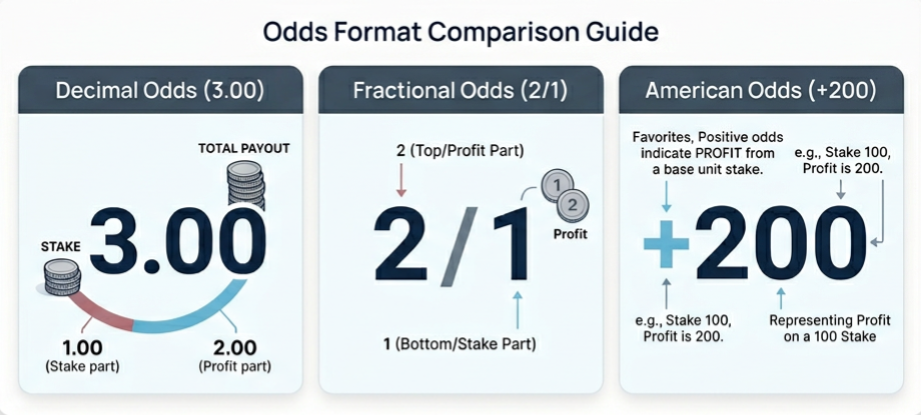
The formula is always the same, regardless of whether you are betting on a favourite or a heavy underdog:
How to Read Decimal Odds at a Glance
The decimal number tells you immediately whether you are looking at a favourite or an underdog, and exactly how much the bookmaker thinks the outcome is worth.
Odds of 2.00 are the break-even point, equivalent to a coin flip at fair odds. Every bet below 2.00 is a favourite (the bookmaker considers it more likely than not to happen). Every bet above 2.00 is an underdog.
| Decimal Odds | What It Signals | EUR 10 Stake: Total Return | EUR 10 Stake: Profit |
|---|---|---|---|
| 1.20 | Heavy favourite | EUR 12.00 | EUR 2.00 |
| 1.50 | Solid favourite | EUR 15.00 | EUR 5.00 |
| 1.80 | Slight favourite | EUR 18.00 | EUR 8.00 |
| 2.00 | Evens (50/50 at fair odds) | EUR 20.00 | EUR 10.00 |
| 2.50 | Slight underdog | EUR 25.00 | EUR 15.00 |
| 4.00 | Underdog | EUR 40.00 | EUR 30.00 |
| 10.00 | Big underdog | EUR 100.00 | EUR 90.00 |
Calculating Payouts: Step-by-Step Examples
The calculation takes a single step. Below are three worked examples covering common scenarios.
Example 1: Backing a favourite A top-four club is listed at 1.65 to win at home. You stake EUR 20.
- Total Return: EUR 20 x 1.65 = EUR 33.00
- Profit: EUR 33.00 – EUR 20.00 = EUR 13.00
Example 2: Backing an underdog An away side is listed at 4.50 to win. You stake EUR 10.
- Total Return: EUR 10 x 4.50 = EUR 45.00
- Profit: EUR 45.00 – EUR 10.00 = EUR 35.00
Example 3: A near-even match Both teams priced closely, with your selection at 2.10. You stake EUR 50.
- Total Return: EUR 50 x 2.10 = EUR 105.00
- Profit: EUR 105.00 – EUR 50.00 = EUR 55.00
The stake is always returned on a winning bet, so the total return figure is what lands in your account.
Converting Decimal Odds to Implied Probability
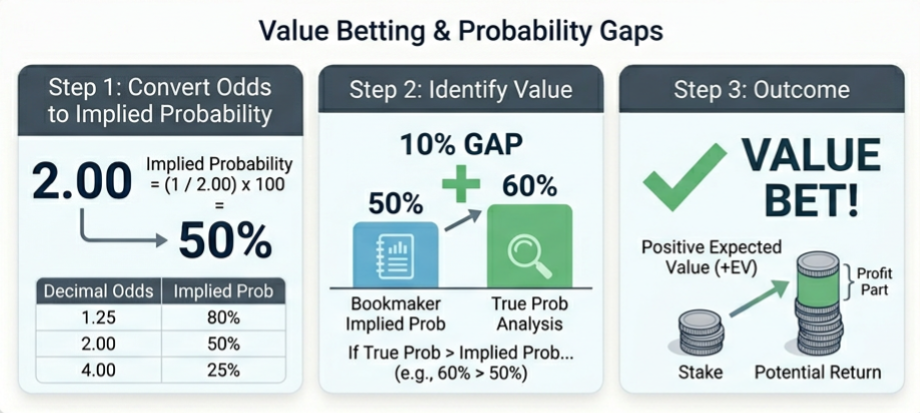
Every decimal odds number contains an implied probability: the percentage chance the bookmaker assigns to that outcome happening. Converting decimal odds to implied probability is a single calculation with no variation between favourites and underdogs, which is one reason professionals and serious bettors prefer this format.
| Decimal Odds | Implied Probability |
|---|---|
| 1.25 | 80% |
| 1.50 | 66.7% |
| 2.00 | 50% |
| 2.50 | 40% |
| 4.00 | 25% |
| 10.00 | 10% |
Decimal Odds and the Bookmaker Margin
If you add up the implied probabilities of all outcomes in a market, the total always exceeds 100%. That excess percentage is the bookmaker’s margin, and it is embedded directly into the decimal odds by pricing each outcome slightly below its fair value.
Take a football match with three outcomes:
| Outcome | Decimal Odds | Implied Probability |
|---|---|---|
| Home Win | 2.10 | 47.6% |
| Draw | 3.40 | 29.4% |
| Away Win | 3.60 | 27.8% |
| Total | 104.8% |
Decimal Odds in Accumulators
Decimal odds make accumulator (parlay) calculations straightforward. To calculate the combined odds of a multiple bet, multiply each selection’s decimal odds together.
For example, a three-leg accumulator with selections at 1.80, 2.20, and 3.00:
1.80 x 2.20 x 3.00 = 11.88 combined odds
On a EUR 10 stake, the total return would be EUR 118.80 (EUR 108.80 profit). With fractional odds, reaching the same result requires converting each leg first. Decimal odds make the maths immediate and transparent.
Converting Other Formats to Decimal
If you encounter fractional or American odds and want to convert them to decimal, use the following:
Decimal = (Numerator / Denominator) + 1 Example: 5/2 = (5 / 2) + 1 = 3.50
Decimal = (American Odds / 100) + 1 Example: +250 = (250 / 100) + 1 = 3.50
Decimal = (100 / Absolute Value of American Odds) + 1 Example: -200 = (100 / 200) + 1 = 1.50
How to Switch to Decimal Odds on Betting Sites
Most major betting sites default to fractional odds in the UK and Ireland, and American odds in the US, but switching to decimal is straightforward. The odds format setting is usually found in your account preferences or in a dropdown at the top of the odds display page.
On betting exchanges, decimal odds are the default format and cannot be changed, as they are standard for exchange trading. This is another reason to become comfortable with decimal odds: the exchange market, where the sharpest odds are often found, operates exclusively in this format.
FAQ
QWhat is the difference between decimal odds and fractional odds?
QWhat do decimal odds of 1.00 mean?
QWhich decimal odds represent an even-money bet?
QWhy do betting exchanges use decimal odds by default?
QHow do decimal odds help identify value bets?
QCan decimal odds go below 1.00?