

















































































































































































































Fractional odds are the traditional odds format used by bookmakers in the United Kingdom and Ireland. They display how much profit a bettor stands to win relative to the amount staked. For example, odds of 7/2 mean a bettor earns 7 units of profit for every 2 units wagered, plus the original stake returned on a winning bet.
Table of Contents
This format is also widely used in horse racing worldwide and remains the default display on many major betting sites. Despite appearing intimidating at first, fractional odds follow a straightforward structure once the underlying logic clicks.
This guide covers everything from reading and calculating fractional odds to converting them into decimal and American formats. It also includes practical tables, worked examples, and a breakdown of how to identify favorites and underdogs at a glance.
- Fractional odds show your potential profit relative to your stake. A bet at 5/1 means you win 5 units of profit for every 1 unit wagered, plus your stake back.
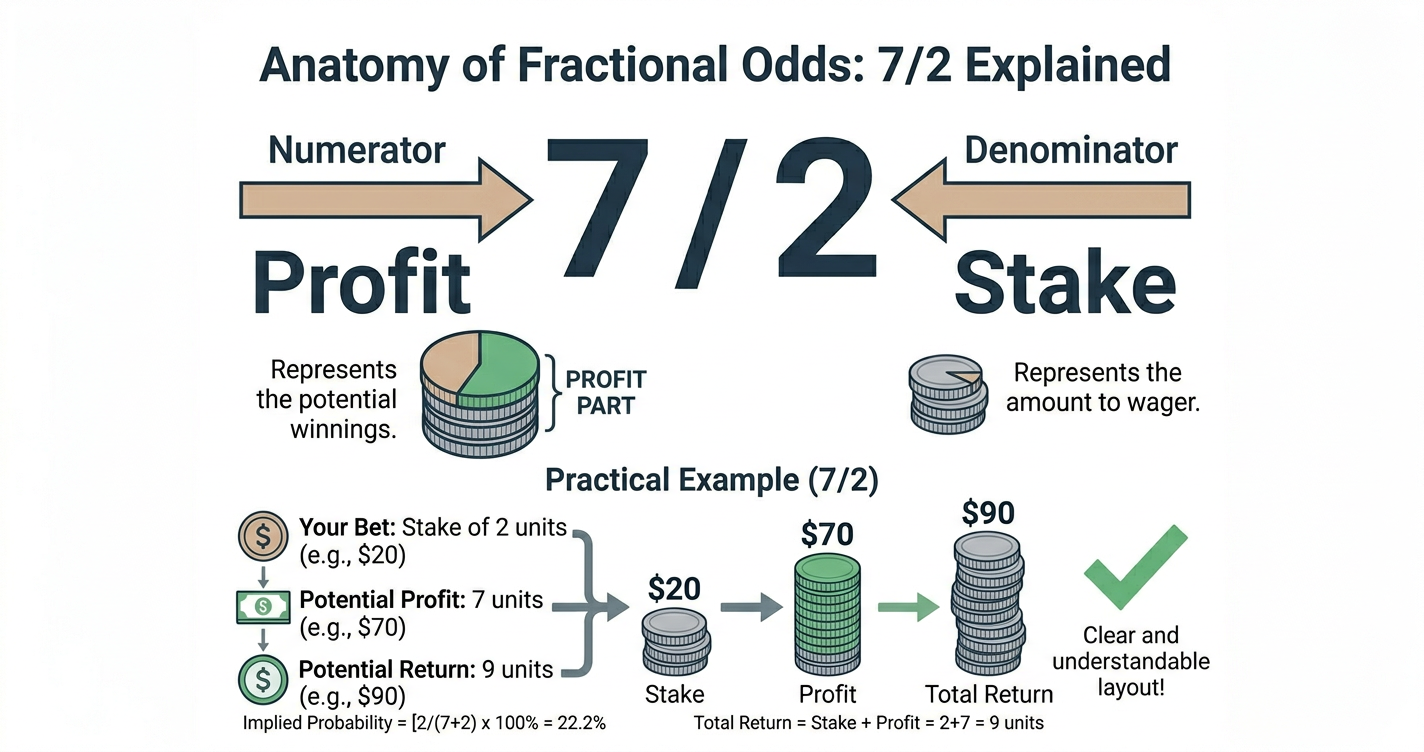
- The left number (numerator) represents the profit, and the right number (denominator) represents the stake required to earn that profit.
- When the numerator is larger than the denominator (e.g., 4/1), the selection is an underdog. When the denominator is larger (e.g., 1/4), the selection is a favorite.
- To calculate winnings: Profit = Stake × (Numerator ÷ Denominator). Total Return = Profit + Stake.
- To find implied probability: Probability (%) = Denominator ÷ (Numerator + Denominator) × 100. For example, 3/1 odds imply a 25% chance.
- Converting to decimal odds is simple: divide the fraction and add 1. For example, 5/2 becomes 3.50 in decimal format.
How Fractional Odds Work
Fractional odds express the relationship between profit and stake as a fraction. The first number (numerator) is the profit, and the second number (denominator) is the stake needed to generate that profit.
The format reads as “X to Y.” For example:
- 5/1 reads as “five to one.” For every 1 unit staked, the bettor wins 5 units of profit.
- 8/11 reads as “eight to eleven.” For every 11 units staked, the bettor wins 8 units of profit.
A crucial distinction separates fractional odds from decimal odds: fractional odds show only the profit, not the total return. The original stake is always returned on top of the profit if the bet wins. A winning bet at 5/1 with a €10 stake returns €60 total (€50 profit plus the €10 stake).
Bookmakers sometimes display equivalent fractions. Odds of 6/4 and 3/2 represent the same price because the ratio is identical. Bookmakers always reduce fractions to their simplest form, so bettors will see 3/2 rather than 6/4 on a betting slip.
How to Read Fractional Odds
Fractional odds fall into three categories based on the relationship between the numerator and denominator. Understanding these categories makes it easy to assess any price at a glance.
Odds Against (Numerator Larger Than Denominator)
When the first number is larger than the second, the profit exceeds the stake. These are called “odds against” and represent selections the [INTERNAL LINK: bookmaker → /how-do-bookmakers-work] considers less likely to win. The bigger the first number relative to the second, the larger the potential return and the less likely the outcome.
Examples: 2/1, 5/2, 10/1, 33/1.
Evens (1/1)
Odds of 1/1, known as “evens” or “even money,” pay a profit equal to the stake. A €20 bet at evens returns €40 total (€20 profit plus the €20 stake). Evens represent approximately a 50% implied probability before the bookmaker’s margin is applied.
Odds On (Denominator Larger Than Numerator)
When the second number is larger than the first, the profit is less than the stake. These are called “odds on” and represent selections the bookmaker considers more likely to win. The bettor must risk more than the potential profit.
Examples: 1/2, 4/9, 1/5, 2/7.
Quick-Reference Table: Common Fractional Odds
| Fractional Odds | Type | Profit on €10 Stake | Total Return |
|---|---|---|---|
| 10/1 | Odds against | €100.00 | €110.00 |
| 5/1 | Odds against | €50.00 | €60.00 |
| 3/1 | Odds against | €30.00 | €40.00 |
| 2/1 | Odds against | €20.00 | €30.00 |
| 6/4 (3/2) | Odds against | €15.00 | €25.00 |
| 5/4 | Odds against | €12.50 | €22.50 |
| 1/1 (Evens) | Even money | €10.00 | €20.00 |
| 4/5 | Odds on | €8.00 | €18.00 |
| 1/2 | Odds on | €5.00 | €15.00 |
| 1/4 | Odds on | €2.50 | €12.50 |
| 1/10 | Odds on | €1.00 | €11.00 |
How to Calculate Winnings From Fractional Odds
Calculating payouts from fractional odds requires one simple formula:
Profit = Stake × (Numerator ÷ Denominator)
Total Return = Profit + Stake
Worked Example 1: Odds Against (7/2)
A bettor places €20 on a selection at 7/2.
- Profit = €20 × (7 ÷ 2) = €20 × 3.5 = €70.00
- Total Return = €70 + €20 = €90.00
Worked Example 2: Odds On (4/9)
A bettor places €45 on a strong favorite at 4/9.
- Profit = €45 × (4 ÷ 9) = €45 × 0.444 = €20.00
- Total Return = €20 + €45 = €65.00
Worked Example 3: Evens (1/1)
A bettor places €30 on a selection at evens (1/1).
- Profit = €30 × (1 ÷ 1) = €30 × 1 = €30.00
- Total Return = €30 + €30 = €60.00
Worked Example 4: Long Odds (25/1)
A bettor places €5 on a longshot at 25/1.
- Profit = €5 × (25 ÷ 1) = €5 × 25 = €125.00
- Total Return = €125 + €5 = €130.00
The formula works the same regardless of whether the odds are odds-on, even money, or odds-against. It also works for any stake amount. Bettors are not limited to wagering the exact amount shown in the denominator.
Fractional Odds and Implied Probability
Every set of odds carries an implied probability, which is the bookmaker’s estimation of how likely an outcome is to occur. Converting fractional odds to probability helps bettors assess whether the odds represent genuine value.
The formula:
Implied Probability (%) = Denominator ÷ (Numerator + Denominator) × 100
Worked Example
For odds of 3/1:
- Implied Probability = 1 ÷ (3 + 1) × 100 = 1 ÷ 4 × 100 = 25%
This means the bookmaker estimates the outcome has roughly a 25% chance of happening, before accounting for the bookmaker’s margin.
Implied Probability Table
| Fractional Odds | Implied Probability |
|---|---|
| 1/10 | 90.91% |
| 1/5 | 83.33% |
| 1/3 | 75.00% |
| 1/2 | 66.67% |
| 4/5 | 55.56% |
| 1/1 (Evens) | 50.00% |
| 6/5 | 45.45% |
| 6/4 (3/2) | 40.00% |
| 2/1 | 33.33% |
| 3/1 | 25.00% |
| 5/1 | 16.67% |
| 10/1 | 9.09% |
| 20/1 | 4.76% |
| 50/1 | 1.96% |
The smaller the fraction, the higher the implied probability and the more likely the bookmaker believes the outcome is. Odds of 1/5 imply an 83.33% chance, while odds of 5/1 imply just 16.67%.
One important note: the total implied probability across all outcomes in a market always exceeds 100%. The difference is the bookmaker’s overround (also called “vig” or “juice”), the built-in margin that ensures the bookmaker profits over time. Understanding how this margin is built into every market is essential for identifying when odds actually offer value.
The mathematical relationship between odds and probability has been studied since the 17th century, originating from work by mathematicians Blaise Pascal and Pierre de Fermat on games of chance. The Wikipedia article on odds provides a thorough overview of the theoretical foundations for readers who want to explore the mathematics further.
Favorites vs Underdogs in Fractional Odds
Identifying favorites and underdogs in fractional odds is straightforward once the structure clicks.
If the numerator is smaller than the denominator, the selection is a favorite. The bettor wins less profit than the amount staked because the outcome is considered more likely.
- 1/3 = Strong favorite. The bettor risks €3 to win €1 profit.
- 4/7 = Moderate favorite. The bettor risks €7 to win €4 profit.
If the numerator is larger than the denominator, the selection is an underdog. The bettor wins more profit than the amount staked because the outcome is considered less likely.
- 3/1 = Clear underdog. The bettor risks €1 to win €3 profit.
- 9/2 = Significant underdog. The bettor risks €2 to win €9 profit.
Practical Example: Premier League Match
Imagine a bookmaker prices a Premier League match between Manchester City and Wolverhampton Wanderers:
| Selection | Fractional Odds | Type | Implied Probability |
|---|---|---|---|
| Manchester City Win | 2/5 | Favorite | 71.43% |
| Draw | 3/1 | Underdog | 25.00% |
| Wolverhampton Win | 7/1 | Longshot | 12.50% |
The total implied probability adds up to 108.93%, which means the bookmaker has a built-in margin of approximately 8.93%. Manchester City at 2/5 is the clear favorite, where a bettor must stake €5 to win just €2 in profit. Wolverhampton at 7/1 is the longshot, where a €1 stake returns €7 in profit if they pull off an upset.
These prices are not fixed. Bookmakers adjust them as money flows in and the opening odds shift toward the closing line which often reflects a more accurate probability by kickoff.
How to Convert Fractional Odds to Decimal and American
Switching between odds formats is useful when comparing prices across international bookmakers. Most betting sites allow bettors to toggle between formats in their settings, but knowing the conversion formulas helps in any situation.
Fractional to Decimal
Decimal Odds = (Numerator ÷ Denominator) + 1
Simply divide the fraction and add 1. The “+1” accounts for the returned stake, which decimal odds include in the displayed number.
| Fractional | Calculation | Decimal |
|---|---|---|
| 5/1 | (5 ÷ 1) + 1 | 6.00 |
| 3/2 | (3 ÷ 2) + 1 | 2.50 |
| 1/1 | (1 ÷ 1) + 1 | 2.00 |
| 4/5 | (4 ÷ 5) + 1 | 1.80 |
| 1/4 | (1 ÷ 4) + 1 | 1.25 |
Fractional to American
The conversion depends on whether the odds are odds-against or odds-on.
For odds against (numerator ≥ denominator):
American Odds = (Numerator ÷ Denominator) × 100
Example: 5/2 → (5 ÷ 2) × 100 = +250
For odds on (denominator > numerator):
American Odds = −(Denominator ÷ Numerator) × 100
Example: 1/3 → −(3 ÷ 1) × 100 = −300
The positive and negative signs in American odds (moneyline) follow the same favorite/underdog logic, just expressed differently.
Full Conversion Table
| Fractional | Decimal | American | Implied Probability |
|---|---|---|---|
| 10/1 | 11.00 | +1000 | 9.09% |
| 5/1 | 6.00 | +500 | 16.67% |
| 3/1 | 4.00 | +300 | 25.00% |
| 2/1 | 3.00 | +200 | 33.33% |
| 3/2 | 2.50 | +150 | 40.00% |
| 1/1 | 2.00 | +100 | 50.00% |
| 4/5 | 1.80 | -125 | 55.56% |
| 1/2 | 1.50 | -200 | 66.67% |
| 1/3 | 1.33 | -300 | 75.00% |
| 1/5 | 1.20 | -500 | 83.33% |
| 1/10 | 1.10 | -1000 | 90.91% |
Fractional vs Decimal vs American Odds: Key Differences
All three formats express the same underlying concept (the relationship between a stake and potential return) but they present the information differently.
| Feature | Fractional | Decimal | American |
|---|---|---|---|
| Format | Two numbers separated by a slash (e.g., 5/2) | Single number with decimals (e.g., 3.50) | Positive or negative number (e.g., +250 or -150) |
| What it shows | Profit relative to stake | Total return (profit + stake) | Amount won on a 100-unit wager (positive) or amount needed to win 100 units (negative) |
| Primary regions | United Kingdom, Ireland | Europe, Australia, Canada | United States |
| Includes stake in display | No, profit only | Yes, total return | No, profit only |
| Best for | Quick profit assessment, horse racing | Comparing odds across markets, parlays/accumulators | Understanding favorite/underdog via +/− sign |
| Ease of parlay calculation | Difficult, fractions don’t multiply cleanly | Easy, multiply decimal odds together | Moderate, requires conversion first |
Decimal odds are the most practical format for comparing odds across bookmakers because the total return is visible in a single number. Fractional odds remain popular for their traditional clarity in expressing profit ratios. American odds are primarily relevant for bettors accessing US sportsbooks.
Most online betting sites allow bettors to switch between all three formats in the account settings or odds display preferences.
FAQ
QAre Fractional Odds the Same as UK Odds?
QWhat Does Odds Against Mean?
QWhat Does Odds On Mean?
QWhat Are Even Money Odds (1/1)?
QCan I Switch Odds Formats on Betting Sites?
QDo Fractional Odds Work in Accumulator (Parlay) Bets?